A sidewall swelling indicates damage to the tyre carcass substructure — this page explains typical causes on a Volkswagen Golf Mk7, including driving over kerbs at a sharp angle.
| A swelling in the sidewall of the tyre indicates that the
substructure of the carcass has been damaged. |
|
|
|
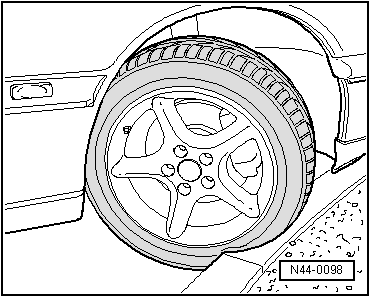
| Typical causes for such damage include, for example, driving
over kerbs at a sharp angle. |
| Pinching the tyre in this way can damage the carcass. |
| The substructure of the tyre is stretched so far that
individual fibres in the carcass may be broken. |
| The extent of the damage depends on the speed of impact, the
angle of impact, the tyre pressure, the axle load and the type
of obstacle. |
|
|
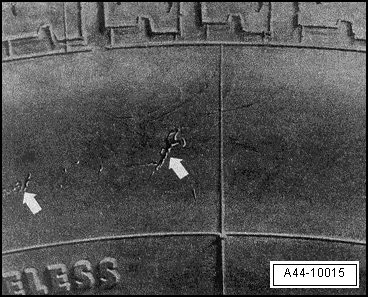
|
| Pinch marks on tyre sidewall -arrows- |
 Note Note
| Driving over kerbs should be avoided. |
| If you cannot avoid driving over a kerb, you should do so
very slowly and as square-on as possible. |
|
|
|
| Interior view of a tyre with a punctured carcass |
| Due to a severe impact, the carcass was pinched on the wheel
rim flange and is ruptured in the contact area. |
|
|

|
| Damage inside tyre due to impact injury (double rupture) |
| Double rupture -arrows- caused
by pinching when a kerb was driven over. Often not detectable
from outside. |
|
|

|
| Cut caused by a sharp-edged obstacle
-arrow- |
|
|

|
Questions & answers
Swellings in the tyre sidewall — Volkswagen Golf Mk7
What do sidewall swellings on a Golf Mk7 tyre indicate?
Internal structural damage — a broken cord or delamination. The tyre can fail catastrophically. Replace immediately.
This type of flat spots may be caused by hard braking on a
rough surface such as a tarmac road.
During this type of braking manoeuv ...
Driving over hard, pointed objects like nails, screws and
the like can pierce the tyre.
This always leads to tyre damage.
...


