This page explains how extreme braking that locks the wheels wears rubber off the tyre's contact patch on a Volkswagen Golf Mk7 — creating flat spots as the tyre slides against the road.
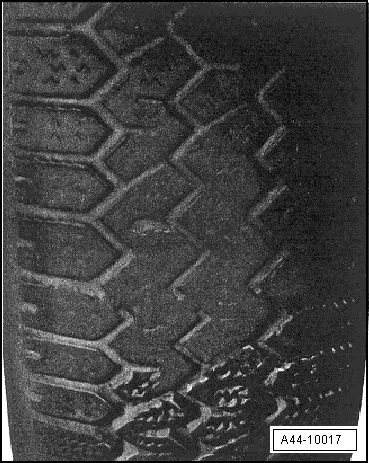
| Flat spots can result from an extreme brake application
which causes the wheels to lock, so that the rubber is worn off
at the contact patch between the tread and the road surface. |
| As the tyres slide over the road surface, friction generates
heat, which also reduces the wear resistance of the tread
material. |
| Not even a highly wear-resistant tread compound can prevent
the flat spots caused by violent braking. |
| Even ABS-controlled brake systems cannot prevent brief
locking of the wheels, and thus, minor flat spots. |
| The degree of such wear depends largely on the vehicle
speed, the road surface and the load placed on the wheel. The
following examples should make this clear. |
| If a vehicle is braked to a standstill on a dry surface with
the wheels locked, the amount of rubber worn from the tyre will
cover an area the size of a postcard and will have a thickness
of: |
| up to 2.0 mm from a speed of 57 km/h (23.8 m braking
distance) |
| up to 3.3 mm from a speed of 75 km/h (41.8 m braking
distance) |
| up to 4.8 mm from a speed of 92 km/h (71.6 m braking
distance) |
|
|
|
| Tyres with such damage must no longer be used and must be
renewed. |
|
|
|
Questions & answers
Flat spots (from locking wheels) — Volkswagen Golf Mk7
What are flat spots on Golf Mk7 tyres?
Flat areas on the tread caused by wheel lock-up during heavy braking. They produce rhythmic thumping at low speed. If severe, the tyre must be replaced.
Tyre noise that can be heard by the human ear is caused by
vibrations which are transmitted by the air from the source of
the sound to our ears.
...


